
Increased App Store Rating
How we boosted the android play store rating from ⭐2.8. to ⭐3.8 within 2 months, within one two-week sprint.
Note: one year later, the rating is a solid 4.2 ⭐
Quick intro about HUMANOO
Humanoo is a holistic health employee wellness product that offers users a wide variety of health content.
- Yoga for beginners to experts
- Physiotherapy training to reduce everyday pain
- HIIT, endurance, and strength online classes
- Meditations for sleep, relaxation, concentration
- A nutritional content base full of both recipes and educational programmes
On top of being Europe’s largest holistic health library, humanoo offers cash-back incentives and community step challenges.
The customer:
As a corporate health SaaS company, Humanoo’s target customer is HR managers and health managers. These customers are looking for a digital wellness solution that they can provide to their employees.
“It is important that the service is well-liked and actually used by employees, so that it is worth the investment for my company.”
The Problem:
In the past, Humanoo has had some stability issues with trackable data (steps, for example). This resulted in a negative experience for users who took part in step-challenges. This has caused many negative reviews and comments on the app store.
When potential clients see the below 3 star ratings, they dismiss the product completely.
Since the trackers are currently stable, many features have been improved, and the overall uxui of the app had a complete facelift, the low rating does not reflect the current product.
How might we increase the app store rating to 3.5, as quickly as possible, so that our sales team no longer loses clients because of the low rating?
Process
1. Defining the ‘who’
Who are the Super Users?
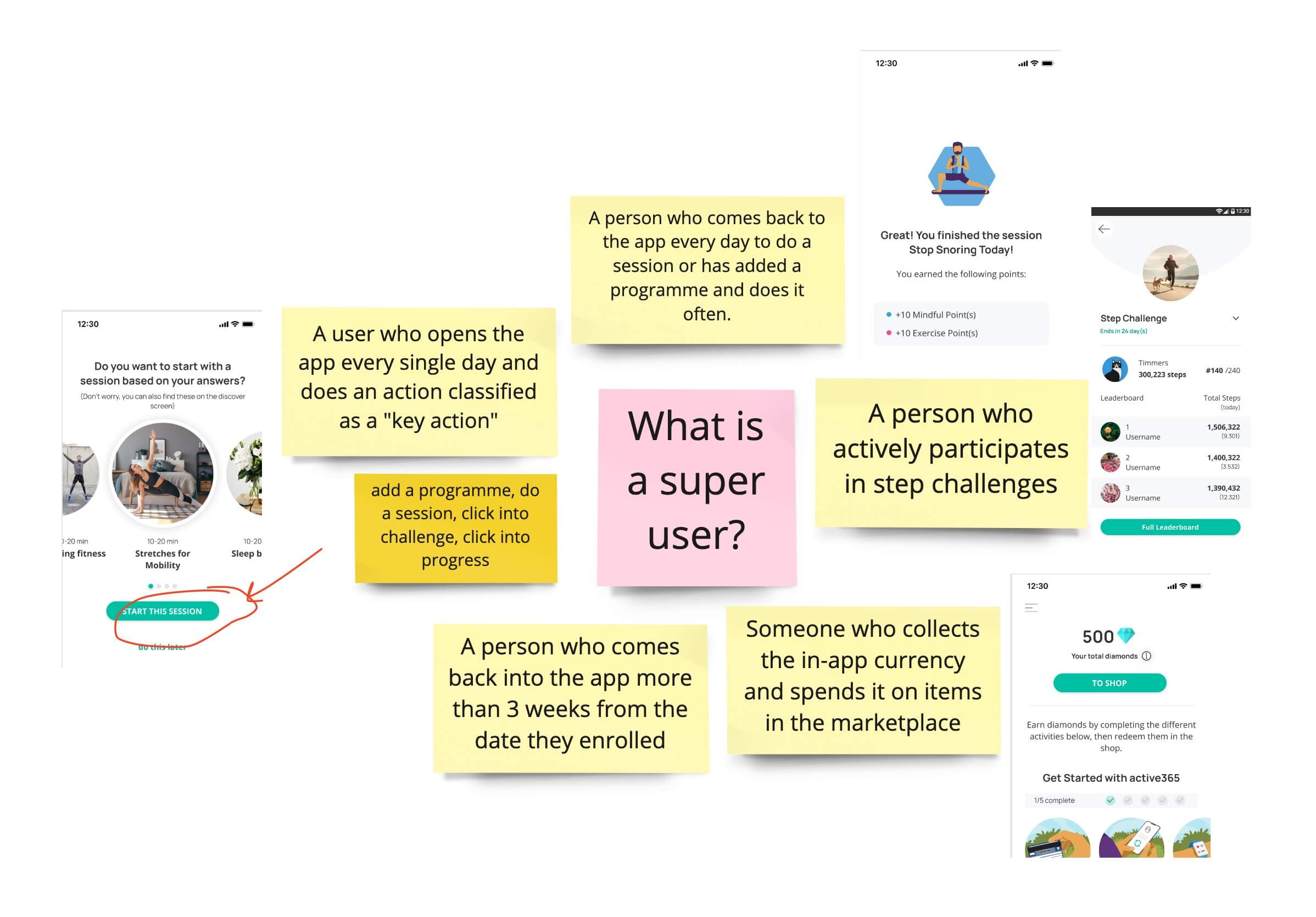
After a brainstorming session, we determined that we needed to target “super users” in hopes that they would be happy enough to rate our product highly. I put together some stickies on miro to define what I think a super user is.
Take away:
- Super users can be defined by quality, rather than quantity of actions.
- Users who actively engage with the product, not just ‘opening’ or clicking on pushes
- Since we give out rewards (money) a good user to target is one who actually received money (or other reward) from us.
2. Refining the ‘who’
What do super users do?
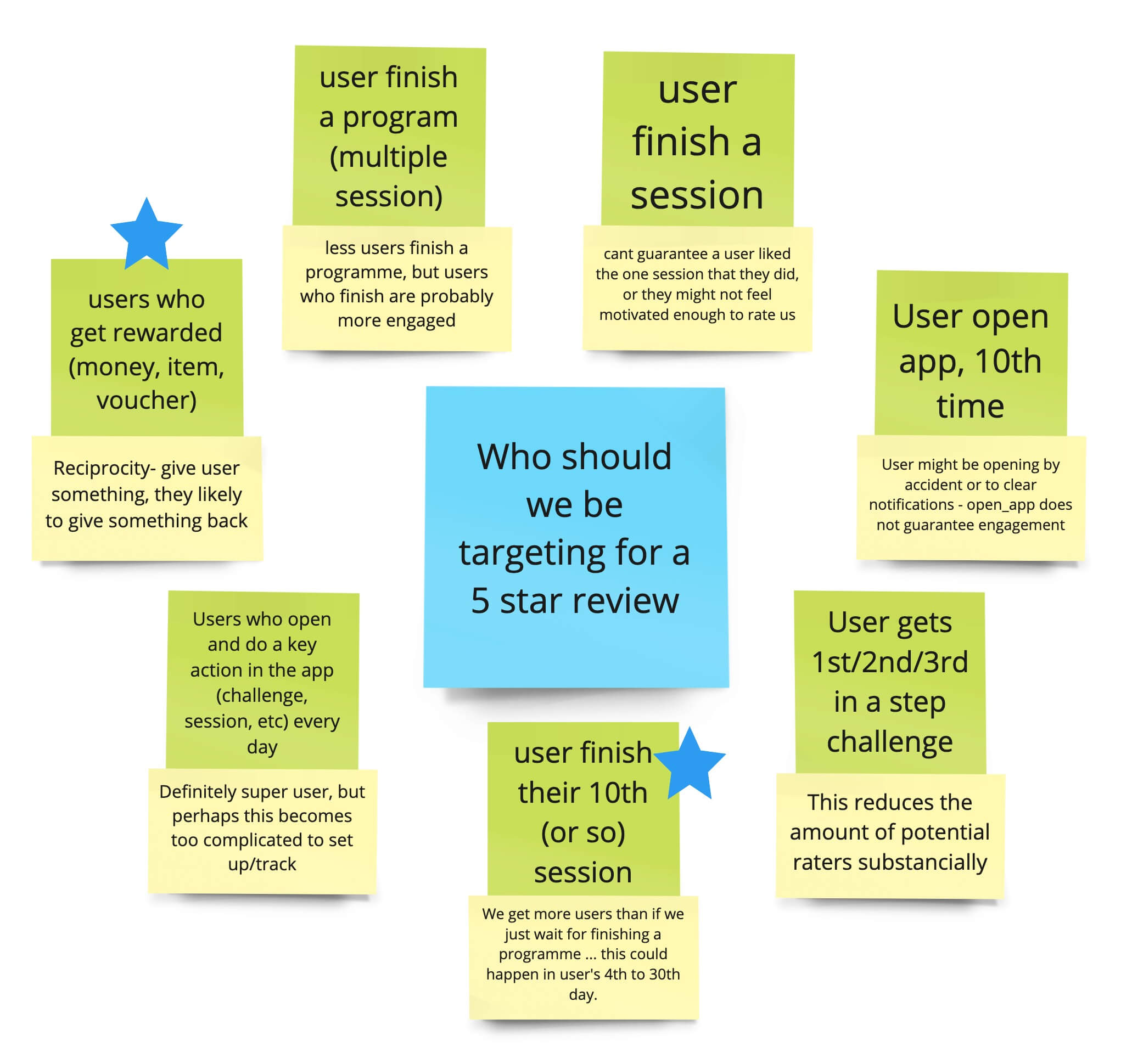
Now that we have a more clear picture of what kind of user we want to target (users who do a meaningful action), we need to define which meaningful action we want to target. I narrowed it down to two targets.
Target 1: Users who get a reward. Focus on the reciprocity principle for persuasive UX. Always try to give something to your users before you ask anything from them.
Target 2: Users who finish their # session. In the end, we chose 8 sessions, because when looking at the average number of sessions done per week per user, it fluctuated between 8 and 9. We chose week as the basis because we want to target users early on in their journey, but not too early.
3. Creating the flow
What do super users do?
As we were brainstorming, we also asked ourselves “how do we try and separate unhappy users with happy users? to reduce negative reviews“.
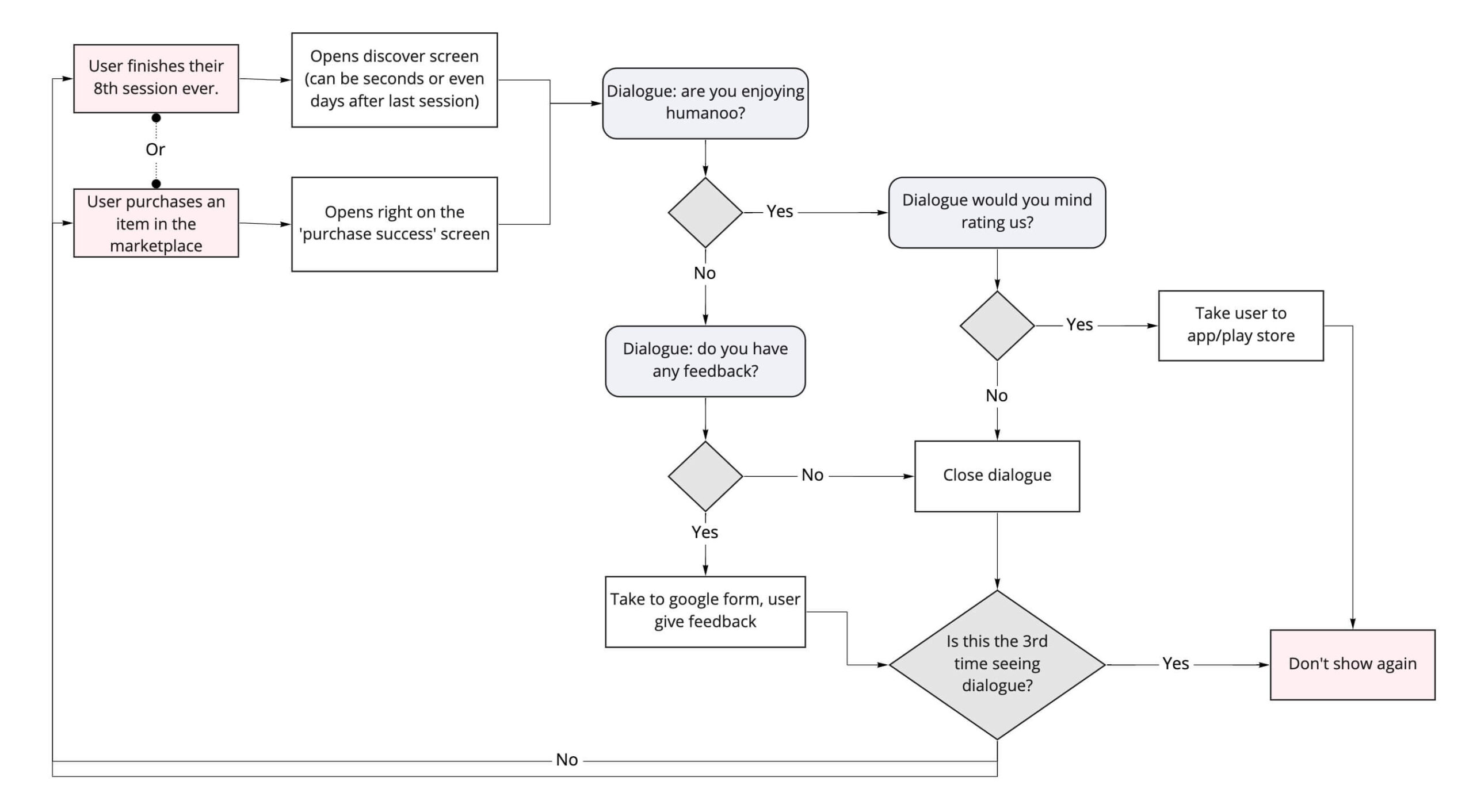
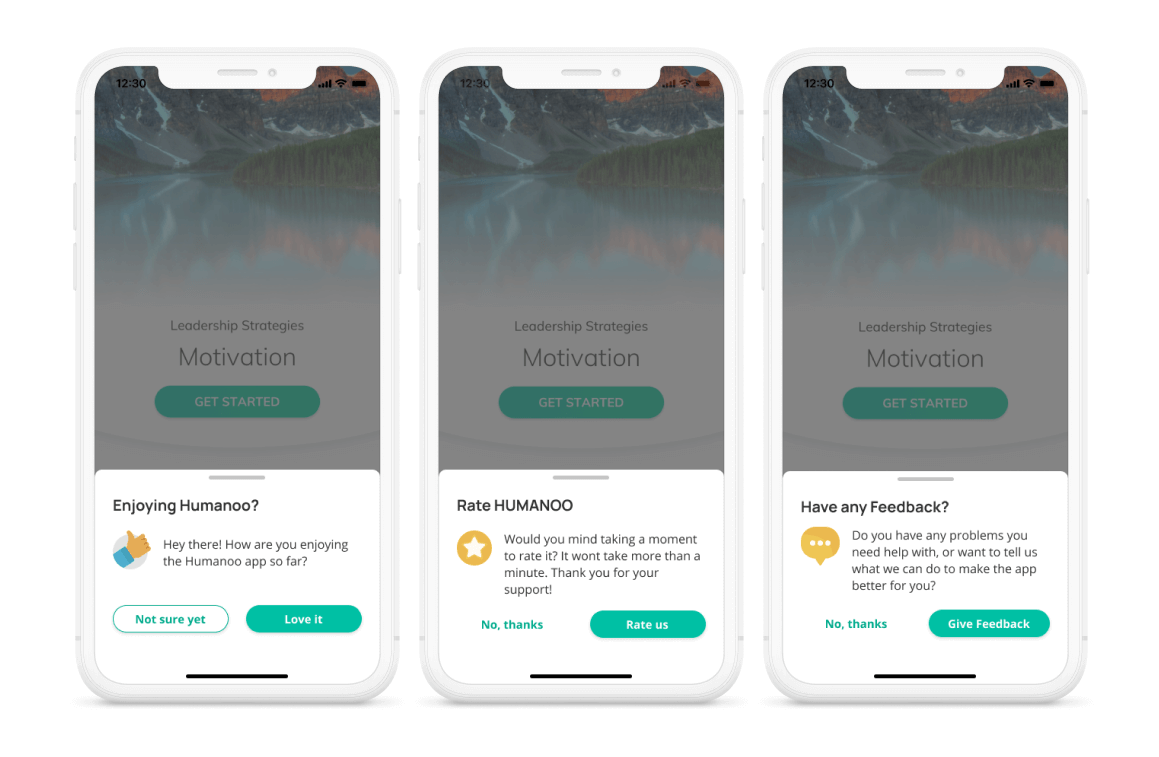
To do this, we created a flow where users are first asked if they are happy, and if not, they will be redirected to a form where they can give feedback. One thing that went well was that we included the developers early on in the project. With their input, we were about to come up with a solution that could be implemented within one week.
Key learning:
With the developer’s input, we realised that we can not see what user’s click on “rate us” and actually rate us…. so we decided to just ‘assume’ these users rate us, and never show them the popup again. We plan to look at the numbers of clicks versus ratings and adjust this flow in the future if necessary.
4. Refining the flow
With this version of the flow confirmed by all stakeholders (CPO, product owner, developers), the next step is to create wireframes and a higher fidelity flow.
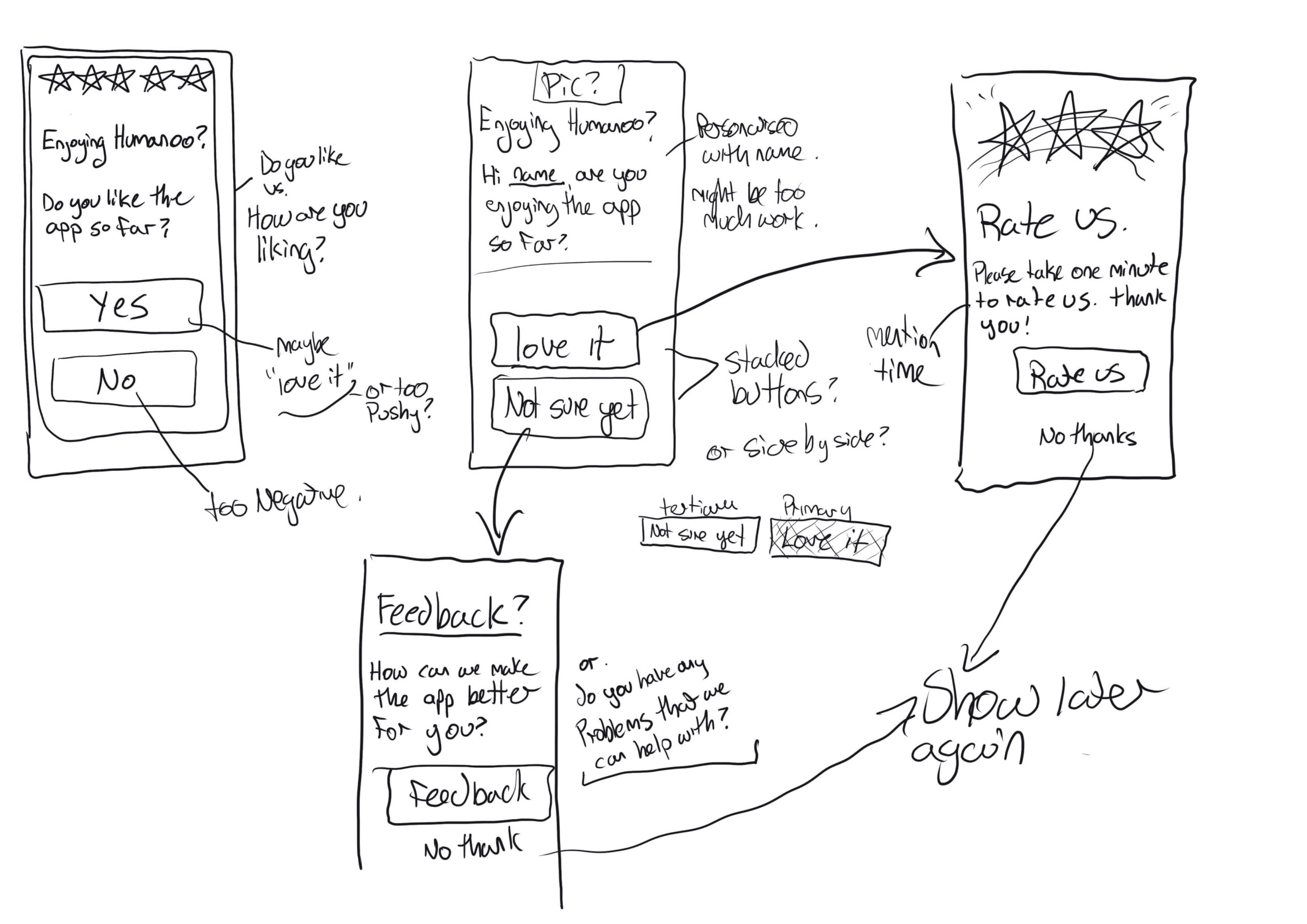
I like to take this opportunity to test out copy, as good UX copywriting is just as important as a nice design.
I am not a copywriter by trade, but since our company is small and lacks a proper ux copywriting team, I write the copy myself while getting feedback from other colleagues.
Preference Testing:
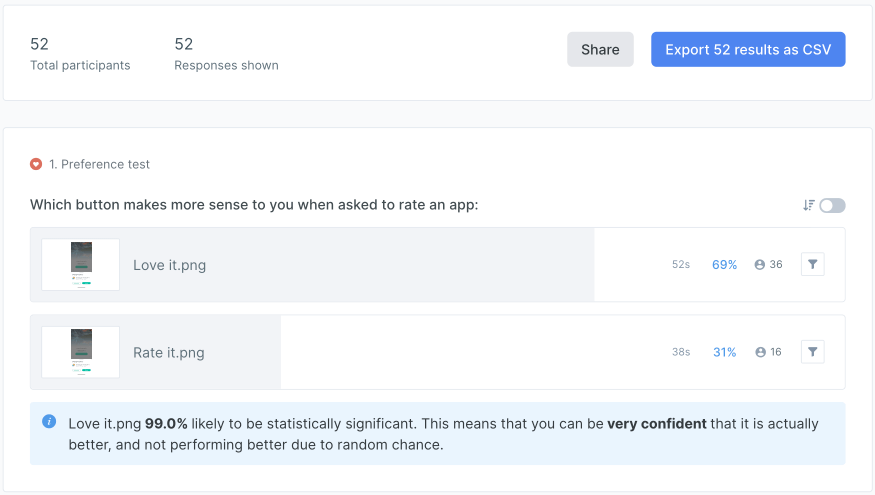
I wasn’t sure if “love it” is too strong for the continue button copy, so I decided to test it with a simple preference test. I used “usability hub” and bought an audience that ranges from 30-60 years old, male and female, to emulate our user.
5. Ready to ship
I had the idea to show the stars in the app, so that the user can rate us directly from the popup without taking the user to the app/play store. I felt like this is a double win, because users would not see the current negative rating and be discouraged. After workshopping this with our FE developers, we decided it would not be worth the effort, since there were some issues with the system rating module.
One cool outcome that we came to with the developers, was to use a ‘drawer’ component instead of a full page popup. Since this element already exists in our design system, our TTM (time to market) would be substantially reduced.
• I took care of providing the developers with all screen specs, copy/keys, and hyperlinks. Our product owner Marcel wrote the tickets and took care of implementing tracking data.
Quick fun fact: After we implemented this flow, I was working on a new design for the challenge leaderboard. I assumed that for challenges, the daily step total was not necessary, so I removed it from the design. A week after implementation, we got feedback in this rate-us form from people wanting the daily step value back. Because of this, we were able to revert the code and push it back into the app the next week!
Looking Back
looking back 3 months later
When we first launched the feature in May 2021, the android app store rating was at ⭐2.8.
Today, on July 6 2021, the rating has risen to ⭐3.8!
We have reached and exceeded our target of >3.5, and every week we are seeing a steady increase. Although my focus was on the Humanoo Android score because it was the lowest, we did implement this feature across all our apps.
For humanoo iOS, there was an increase in number of ratings, but the rating stayed the same at ⭐4.1
A look at our other apps
Our app is also used as a white-label for insurances in Germany and Switzerland. We implemented this new flow not only for Humanoo, but across all of our apps. Overall, it was a big success!
App1 – Released 2019
ios: Reviews increased by 215. ⭐4.5 stayed ⭐4.5 — -0
android: Reviews increased by 283. ⭐3.4 increased to ⭐4.7 — +1.3
App2 – Released 2020
ios: Reviews increased by 386. ⭐3.9 increased to ⭐4.3 — +0.4
android: Reviews increased by 391. ⭐3.5 increased to ⭐4.3 — +0.8
In conclusion
- By involving developers early on in the process, we were able to work agile and come up with a solution that was both effective and quick to implement.
- We strategically targeted user groups that we classified as ‘super-users’, which we did to increase our odds of getting positive reviews.
- Finally, adding a separate path for feedback reduced the number of negative comments that we receive in the app/play store.